The real Diana
A British frigate of 1794 that fought at Algiers under the Dutch flag and burnt out in a dry dock at Den Helder in 1839.
The model in this build log represents a ship that actually sailed, for 45 years: first for the Royal Navy, then for the Royal Netherlands Navy. This is her career in brief, limited to facts that can be traced to at least one of the sources listed at the end.
Design and construction
Diana belonged to the Artois class, nine 38-gun frigates built to a 1793 design by Sir John Henslow, Surveyor of the Navy: a long, fast ship carrying 18-pounders on the gun deck instead of the usual 12-pounders, the British answer to the big French frigates of the day. Seven were built under contract by private yards on the Thames, two in the Royal Dockyard at Chatham.
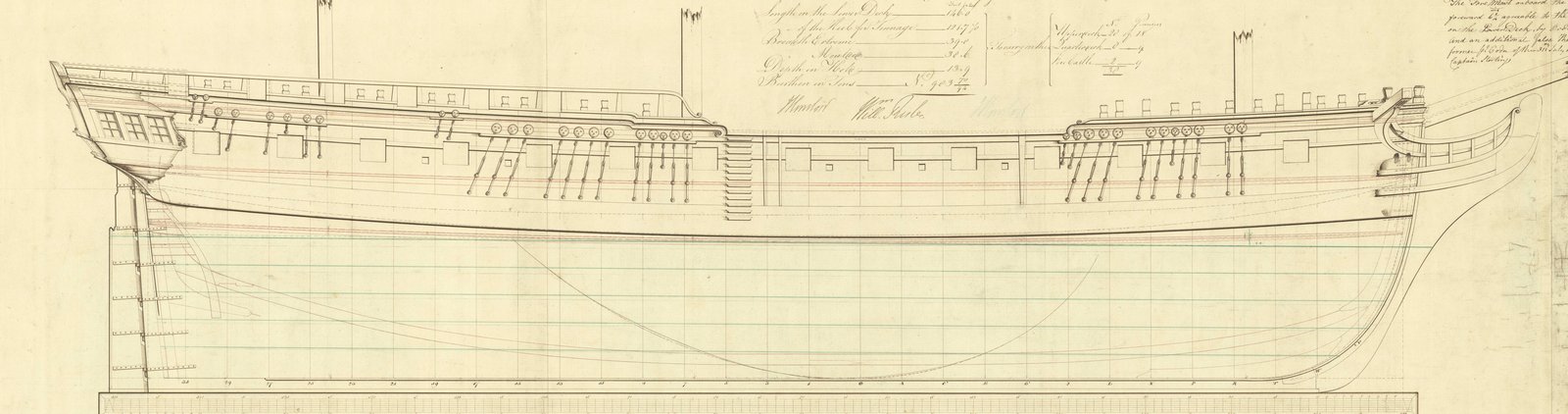
Diana was ordered on 28 March 1793 from Randall & Brent at Rotherhithe, where her keel was laid the same month. She was launched on 3 March 1794 and fitted out at Deptford Dockyard, completing on 6 June 1794. Hull and first outfit together cost £21,991.
Her dimensions according to Winfield: 146 ft 3 in on the gun deck (44.5 m), 121 ft 8½ in on the keel (36.9 m), 39 ft 3½ in in breadth (12.0 m), 13 ft 9 in depth in hold (4.0 m), and 999 43/94 tons builder’s measurement. Her armament as launched: 28 × 18-pounders on the gun deck, 2 × 9-pounders and 12 × 32-pounder carronades on the quarterdeck, and 2 × 9-pounders and 2 × 32-pounder carronades on the forecastle. That is 46 pieces in all, although she remained a “38” on paper. Her designed complement was 270 men, later raised to 315.
British service, 1794 to 1815
Diana spent 21 years under the British flag, almost the whole span of the French Revolutionary and Napoleonic Wars. Her first captain was Jonathan Faulknor (1794 to 1798), followed by Alexander Fraser, John Poo Beresford, Thomas James Maling, Charles Grant and William Ferris. The highlights:
- 1794: on 23 August, two months after completion, she took part in the destruction of the French frigate Volontaire.
- 1796 to 1799: privateer hunting off the Irish coast and in the West Indies; among her prizes L’Indemnité (14 guns), La Mouche (16) and La Medie (10).
- 1800: recaptured the American schooner Sally and Mary.
- 1801: the Egyptian campaign, 8 March to 2 September, which in 1850 earned her surviving crew the clasp “Egypt” to the Naval General Service Medal.
- 1804: convoy duty from Cork to the Leeward Islands; on 7 December she took the Spanish corvette Diligencia (22 guns).
- 1810: the action of 15 November at Saint-Vaast-la-Hougue. Diana, under Captain Grant, used the rising tide to attack the anchored French frigate Amazone; her boats later set fire to the stranded frigate Elisa under fire from the shore batteries, without loss.
- 1811 and 1812: action in the Gironde (24 August 1811) and the recapture of the merchantman Patent (4 February 1812). She was then laid up in ordinary at Plymouth.
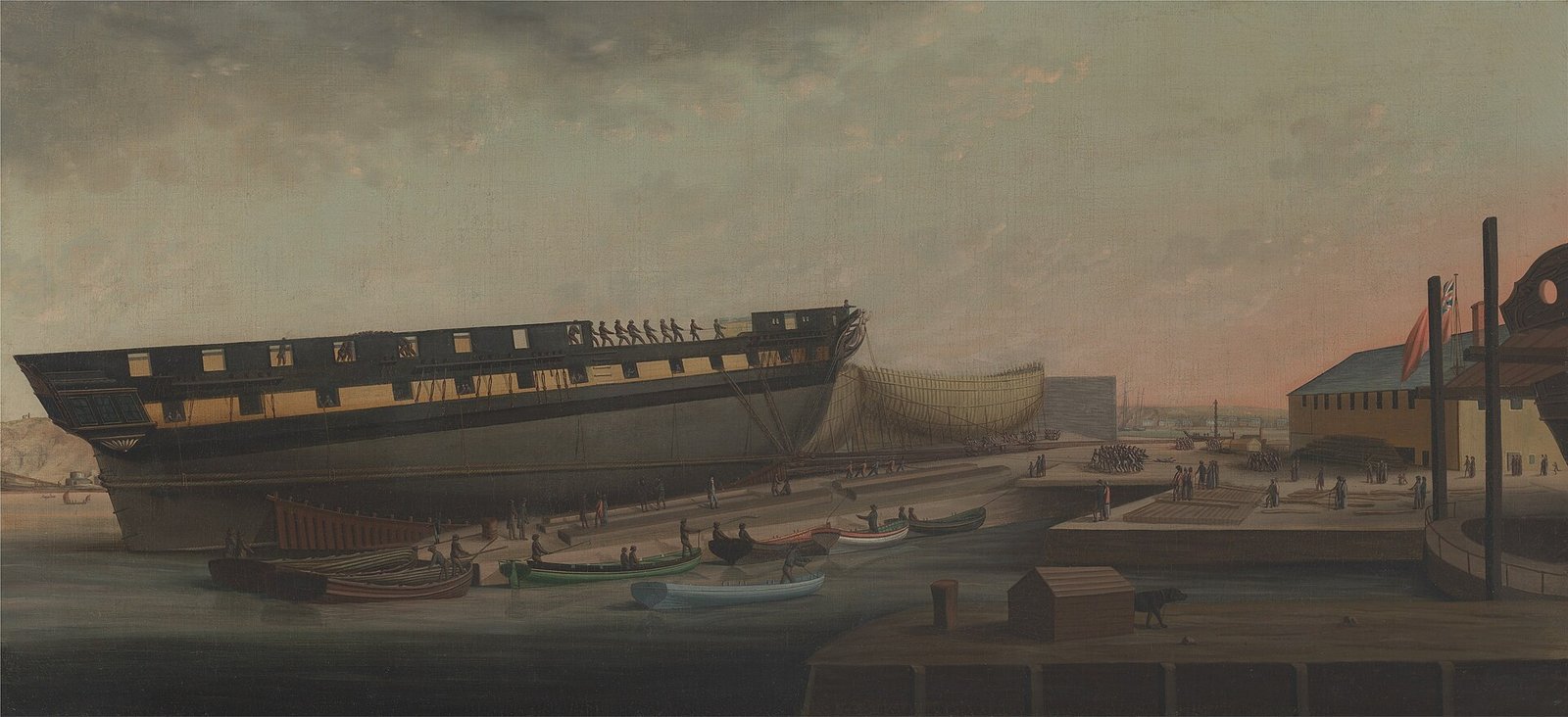
From March 1813 to September 1814 she underwent a large repair at Blackburn’s yard at Turnchapel, followed by refitting at Plymouth Dockyard. The painting above shows the start of that repair: the stripped hull being heaved up the slip, with the crew lining the deck. It is the only known picture of Diana herself from her British years. The refit was still in hand when, on 7 March 1815, the Admiralty sold her to a former enemy, the Netherlands, for £36,796.
Dutch years, 1815 to 1839
After the French period the Dutch navy looked impressive on paper, but many of its ships had been built of poor timber; buying a proven British frigate was therefore a deliberate choice. By Royal Decree of 27 March 1815 Diana was commissioned under Captain Pieter Ziervogel with a crew of 280, and on 19 June 1815 she put to sea under the Dutch flag. In the Dutch reckoning, which counted carronades, she rated as a frigate of 46 guns.
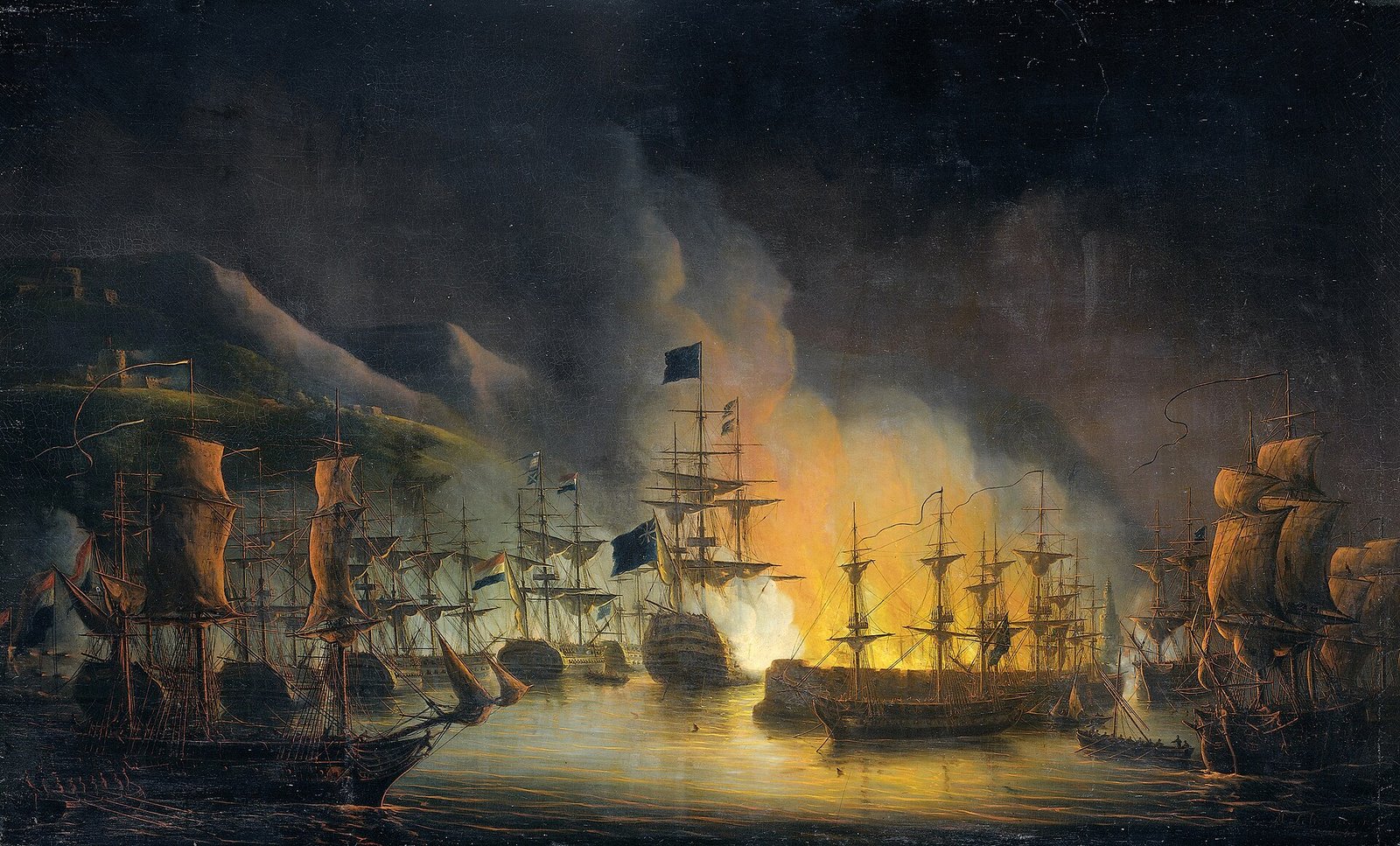
Her best-known action came a year later. In 1816 Britain and the Netherlands agreed to act together against the Dey of Algiers, who held Christian seamen as slaves. A combined fleet under Admiral Lord Exmouth and Vice-Admiral Theodorus Frederik van Capellen bombarded the city on 27 August 1816. The Dutch squadron consisted of five frigates, Melampus, Frederica Sophia Wilhelmina, Diana, Amstel and Dageraad, and the corvette Eendragt. Diana lost six men that day, among them the schoolmaster W. Barendsen and midshipman A.J. Weerts, with 22 wounded; the squadron as a whole lost 13 killed and 52 wounded. The bombardment produced a treaty, signed on 24 September, and the release of 1,083 Christian slaves, followed later by some 3,000 more.
Diana returned to Vlissingen on 26 October 1816 and paid off on 30 October. More than twenty years of intermittent service followed, with M.L. van der Loeff (1819) and J.E. Lewe van Aduard (1824) among her captains, until she was finally decommissioned on 15 November 1838.
The end came quickly. At half past nine in the evening of 16 January 1839 fire broke out while she lay in the dry dock of the naval yard at Willemsoord, Den Helder. Despite every effort the upper works burnt out completely; the fire was only brought under control at ten the next morning. The wreck was advertised for sale in the Nederlandsche Staatscourant of 30 March 1839 and fetched 15,750 guilders.
Paint and colours
What did she look like? The building contract Randall & Brent signed in 1793 does specify the paint, but stops at the hull: the bottom payed with tar, the sides above the wales given three good coats of paint, “the last Coat to be of a yellow cast”. That is the yellow ochre everyone knows from Victory, with the black bands in between.
The contract goes no further than the hull, and yet there is more to say about the rest than you might expect. In the Royal Navy of 1794 paint was preservation first and decoration second. No scheme was laid down: black, yellow ochre and red ochre were cheap and available, and whatever the captain wanted beyond that he often paid for himself. Two habits were fixed, though. The fore-and-aft strakes, the wales and the narrower ones above and between the gunports, were black because tar and lampblack went on there. And all ironwork was blacked against rust, tar with lampblack or black varnish.
That also answers the question model builders get stuck on: what colour were the channels, the heavy boards that hold the shrouds clear of the hull? No source names them in so many words. But they sit in the break of the upper moulding, right in the black band above the ports, and the knees and chains beneath them were iron and therefore black. A channel in bare wood would interrupt that band. Black, then, with the ironwork a slightly different black from the timber.
The hardest figures come from Victory. She was repainted in 2015 after Crick Smith (University of Lincoln) analysed dozens of paint layers from the original timbers. Weatherwork that had been black was given NCS S 8500-N, in effect a very dark grey, and the ochre work NCS S 3020-Y40R. That is useful in scale: true black reads as a hole at 1:64, while that dark grey reads as black.
What does not help are the dockyard models. The contemporary Artois-class model at Greenwich (SLR0572) is finished in bare boxwood with black wales, as dockyard models always were, and the channels are not even fitted. Such models show the shape, not the paint.
The model and the ship
The Caldercraft kit (Jotika, item 9000) is a 1:64 model 1180 mm long, double planked, with some 2,300 copper plates and brass 18- and 9-pounders. According to the manufacturer it shows the ship after her refit of June 1796: closed quarterdeck bulwarks, carronades and a dolphin striker. Piet (pietsan) and I both chose the 1794 configuration with an open rail on the quarterdeck, as on the Admiralty draught above.
The freely available drawings (RMG J5549 to J5555, used in the explorer) are class plans for the Artois class, not Diana’s own sheets; those (J5528, J5534 and J5535) are only available as prints from Royal Museums Greenwich. For detail, every Diana builder turns to David White’s The Frigate Diana (Anatomy of the Ship). The kit departs from it on these points, measured in this build or reported by other builders:
- The keel is 1 to 2 mm too shallow; Anatomy works out at about 6 mm at scale. I glued on a strip exactly one copper plate wide.
- On the kit drawing the bottom of the rudder slopes upward; Anatomy shows the rudder in line with the keel.
- Anatomy (p. 112) shows the sternpost slightly bevelled; at scale a few tenths of a millimetre.
- The kit supplies a Victory-type galley chimney; Diana had a square wooden one.
- The laser-cut moulding along the sternpost is too long and had to be shortened to match the photographs in Anatomy.
- Other builders report a bowsprit angle that fouls the figurehead, mast positions that differ from the Greenwich plans and gun carriages thinner than in Anatomy. HMSFly sums it up on Ships of Scale: “The plans are NOT correct in terms of dimensions.”
Against that, the timber, laser cutting and rigging line are praised by almost everyone. It is an old kit, but a good one; the faults are known and can be corrected. Where that has happened in this build, it is recorded in the reference section under kit errors.
Sources
- Rif Winfield, British Warships in the Age of Sail 1793-1817, Seaforth, 2nd ed. 2008. The basis for all dimensions, dates and captains; consulted here through threedecks and Wikipedia, both of which cite Winfield.
- David White, The Frigate Diana, Anatomy of the Ship, Conway 1987 (reprinted 2004).
- Threedecks: British Fifth Rate frigate ‘Diana’ (1794) and Dutch Fourth Rate frigate ‘Diana’ (1815).
- Ron van Maanen, Het fregat Hr.Ms. Diana en de bevrijding van de christenslaven in 1816, Zeeuws Archief, 2014 (in Dutch). Includes a nineteenth-century print of Diana off Algiers and the 1839 sale advertisement.
- Wikipedia: HMS Diana (1794), Artois-class frigate, Action of 15 November 1810, Bombardment of Algiers (1816).
- Royal Museums Greenwich, Artois class plans J5549 to J5555, via Wikimedia Commons.
- Yale Center for British Art, John Rogers, Heaving up His Majesty’s Frigate ‘Diana’.
- Rijksmuseum, Martinus Schouman, The Bombardment of Algiers.
- Jotika/Caldercraft, HMS Diana kit description.
- Brian Vale, Pitch, Paint, Varnish and the Changing Colour Schemes of Royal Navy Warships, 1775-1815, The Mariner’s Mirror 106/1, 2020, and The Application and Scheme of Paintworks in British Men-of-War, The Mariner’s Mirror 99/3, 2013.
- National Museum of the Royal Navy, HMS Victory re-painted in her Trafalgar colours, 2015, with the paint analysis by Crick Smith (University of Lincoln).
- Model Ship World, 18th Century Warship Color Schemes and HMS Victory paint colours.
- Royal Museums Greenwich, Artois-class dockyard model SLR0572.