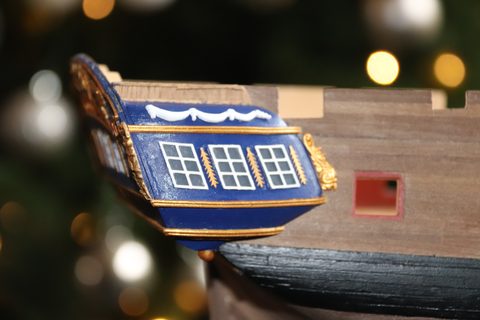
2 December 2018Stern and quarter galleries4 photos
The black strake and the height of the wale
With the hull sanded, I use masking tape to establish the height of the wale and glue the black strake on both sides.
How-to Help from pietsan.
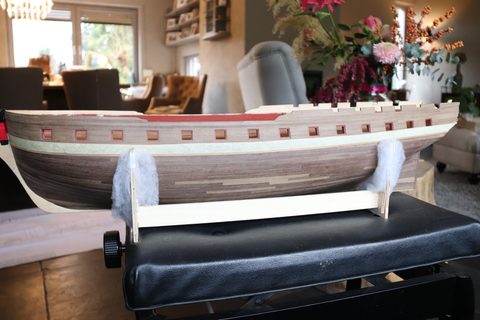
With the hull sanded, I use masking tape to establish the height of the wale and glue the black strake on both sides.
The black strake is only 0.2 mm thinner than the rest of the wale; on Piet's advice I thin it down slightly and skip the varnish.
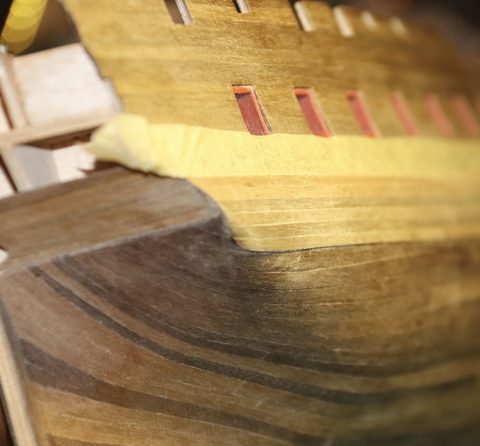
Three coats of black on the wale, the transom dry-fitted with a kink that I file away, and the first quarter gallery turns out to be the wrong way round.
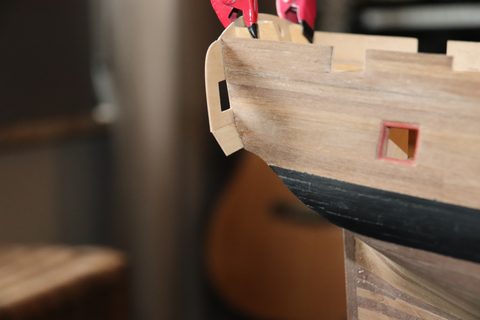
The transom is glued, the underside of the galleries becomes one continuous line with an angular shape, and the decoration set turns out to be two left-hand sets.
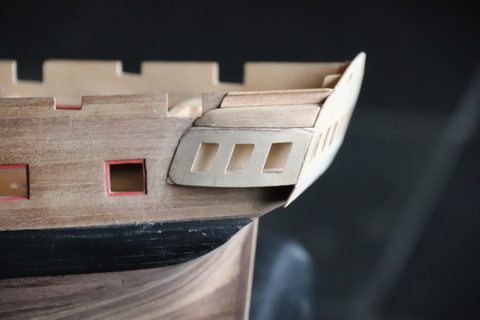
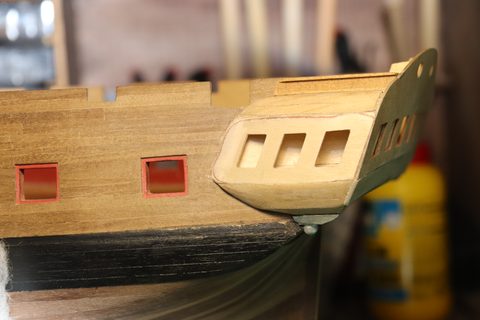
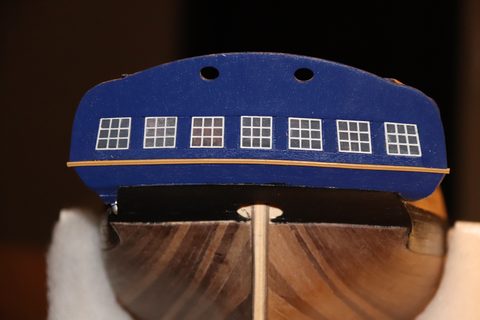
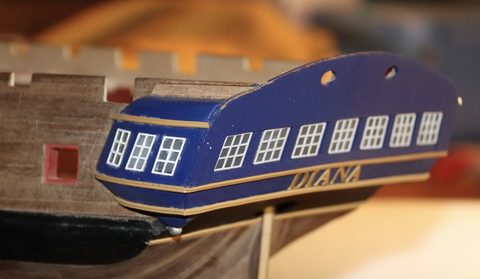
Both quarter galleries are glued on and get three coats of blue along with the transom, the window frames are painted white; the decoration is still missing on the right.
The walnut planking of the transom is done, and three ideas for the windows come in from the forum: film with a grey haze, roughened hard plastic, and aluminium foil behind plastic.
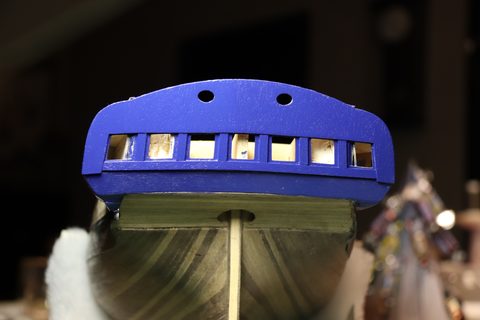
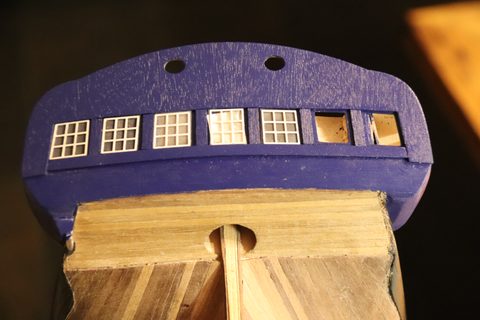
Five window variants tested side by side; the winner is clear plastic with a grey haze of black and white paint, and the windows are in the transom.
The first cast moulding is on the transom in yellow ochre, which looks rather orange to me; Piet recommends thin coats and primer for the metal.
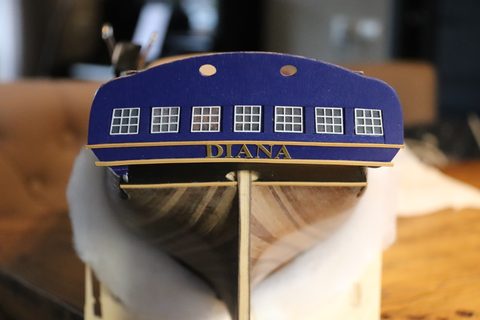
The name is on the transom in unpainted brass, and the decorative strips continue onto the first quarter gallery.
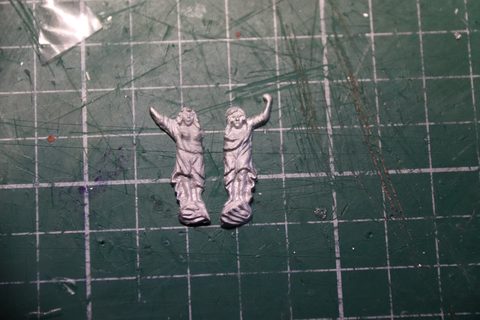
One of the two white metal figures beside the transom is missing part of an arm, the antique gold doesn't cover everywhere, and Piet points out the correct run of the upper moulding.
The first attempt to glue the windows into the gallery fails because of staining CA glue; with a tiny frame as a jig it works the next day.
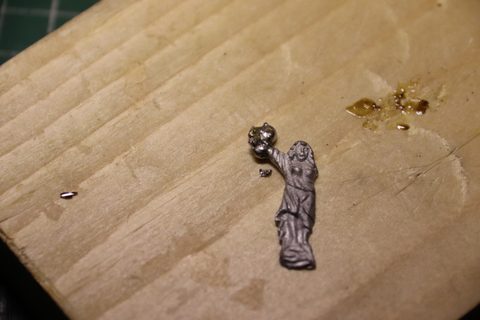
I repair the arm that is too short with solder and a small file; then the figures are aged with a wash and drybrushed in antique gold.
The ladies are back in place with two lions and a figure in the middle; I cut out the white ornament and the red panel gets its decoration.
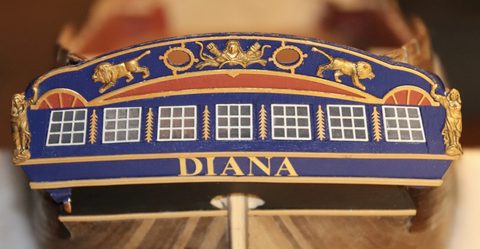
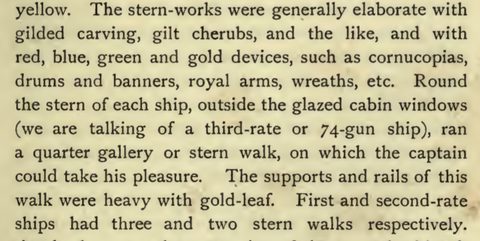
At Piet's suggestion the yellow ochre mouldings become gold too, backed up by Masefield; transom and left-hand gallery are finished.
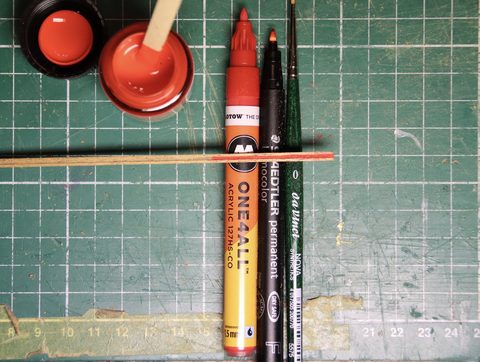
Three ways tested to get the red line into the profile of the mouldings: paint with a brush, a waterproof marker and an acrylic paint marker; the brush wins.
Transom and both galleries are finished with all their ornaments; Piet points out that the upper moulding of the gallery should run to the planksheer and is therefore too long.