Messenger and anchor cable, two different things
Working on the bitts, and while doing so I looked at how the messenger should run. There I ran into a small problem. The hawse holes at the front are too low on my model, and on various other models too: the supplied fitting is just too tall to go under the headrails, so the holes come out below the gun deck. There is no way I can run a cable through there. In the end you will not see any of it, but still.
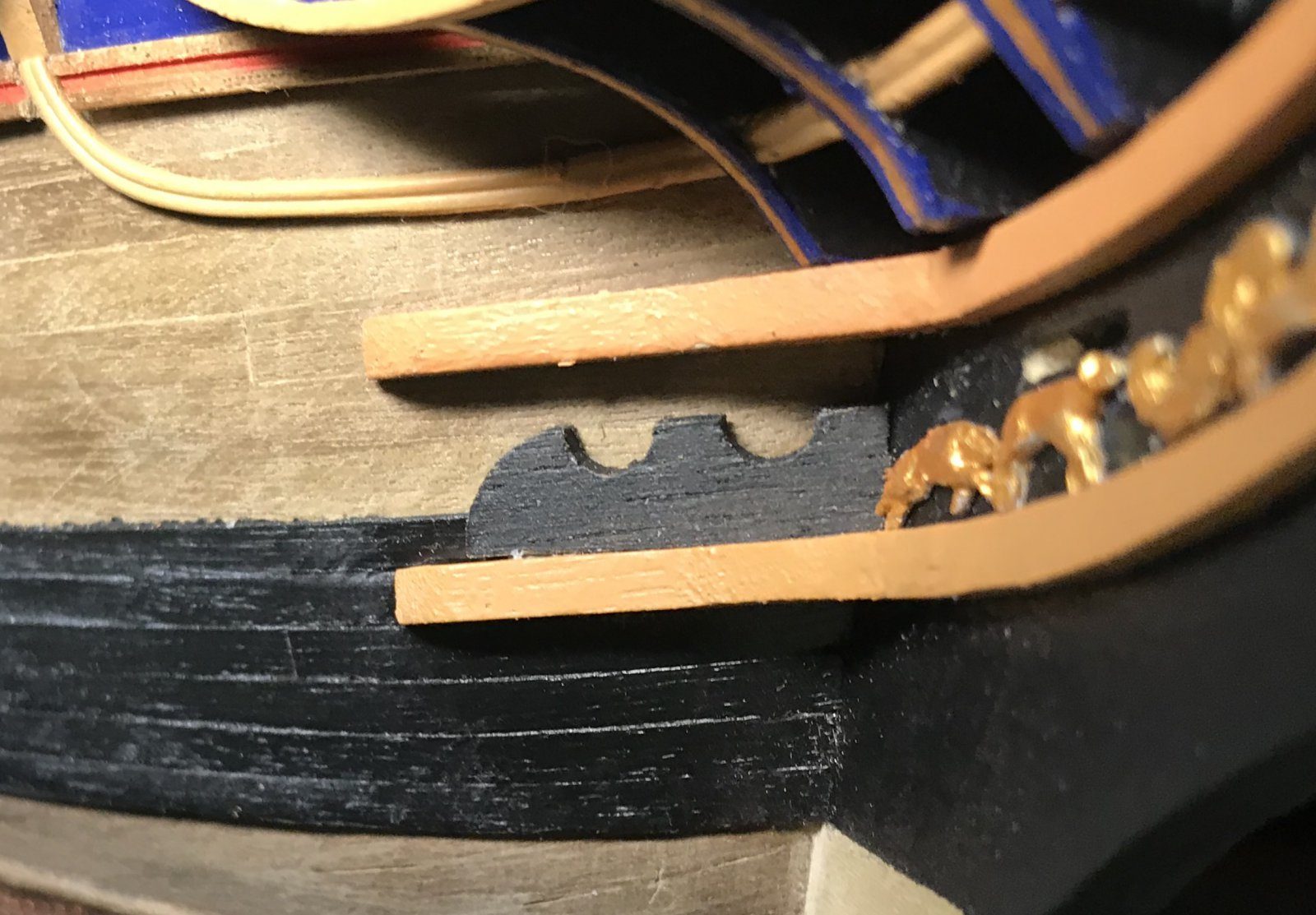
The cause lies with me: the cathead is too far to the left. Had it been further to the right, I could have let the rails rise earlier and there would have been room. Something to bear in mind for anyone else building this model.
An anchor cable is not a messenger
Piet had the same problem, simply because that is how the model is built. On his model the anchor cables on the deck are just glued to the deck and run via the after riding bitts (the Diana has two sets, only the after one is on the model) down through the holes in the grating. After hanging the anchors he drilled the hawse holes and pushed the same cable into them, secured with a drop of wood glue, so it looks as though the cables run through.
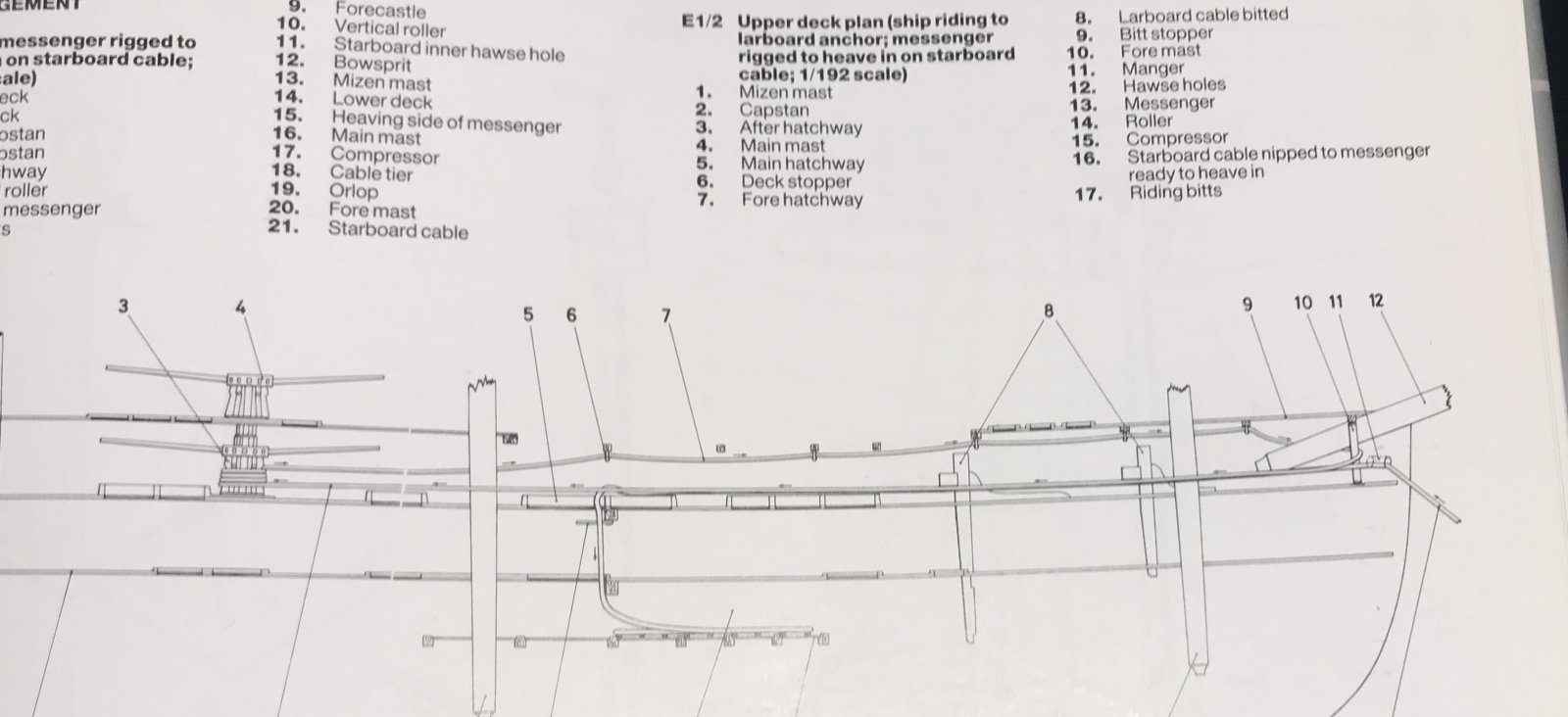
I had mixed up two things. The messenger does not go outboard at all: it is an endless auxiliary rope, led around the capstan and around rollers at the bow, which is lashed to the anchor cable to haul it in. On Piet’s model only the anchor cable is present. In the drawing the messenger runs along the top and back across the deck from the capstan to the bow. That is something I would actually like to fit.
Henk sent a drawing from another book, seen obliquely from above, showing the system as it was used on English ships: the messenger is of left-hand laid rope, at the bow there are two rollers and in front of the capstan two roller fairleads. The turns run from bottom to top on the hauling side, and because the messenger has to be wound the other way round for the other anchor, the ends are knotted together with a separate piece of rope. Jan referred to his Victory build log (page 34 onwards), where he did it exactly like that.
Henk also remarked that the tricky part is that none of this is clearly shown in a single book; for the Victory he sometimes has five books open side by side. Time to study all the information properly before I go any further.